
What We Get Wrong When We Talk About Generations at Work: Part Three
Managers struggle to lead multigenerational teams. In fact, 75% of managers report that managing multigenerational teams is a challenge. After considering how the four generations in the workplace today are alike and the most common challenges faced by multigenerational teams, it’s time to look toward simple, actionable steps every manager can take to make the most of today’s generationally-diverse workplace.
There are six key steps managers can take to make the most of multigenerational teams:
- Communicate openly
- Learn from one another
- Don’t play favorites
- Challenge harmful stereotypes
- Remember how we’re alike
- Develop essential skills
Communicate Openly
One of the most common stumbling blocks for multigenerational teams comes in the form of differences in communication styles, patterns, or defaults. Managers are largely responsible for setting the tone and cadence of communication across a team, so it’s important to strive for clear, transparent communication as compared to siloed or infrequent communication.
Consider having each team member learn more about their personal communication style, and encourage team members to share their own styles and preferences to gain an even deeper understanding of how team members can effectively communicate with one another.
Another helpful tool comes in the form of agreed-upon communication rules. It’s natural for everyone to have their own preferences, but it’s unrealistic to think every piece of information is going to be communicated in person, via email, and over a messaging platform like Slack or Teams. Think through the prompts below when forming your own communication rules, and then you can begin to standardize what types of communication happens where.
- We communicate internally by:
- We communicate externally by:
- We manage calendars using:
- If someone misses a meeting, agendas and notes can be found in:
- We share team or company-wide announcements using:
- We handle urgent or emergency communication by:
Learn From One Another
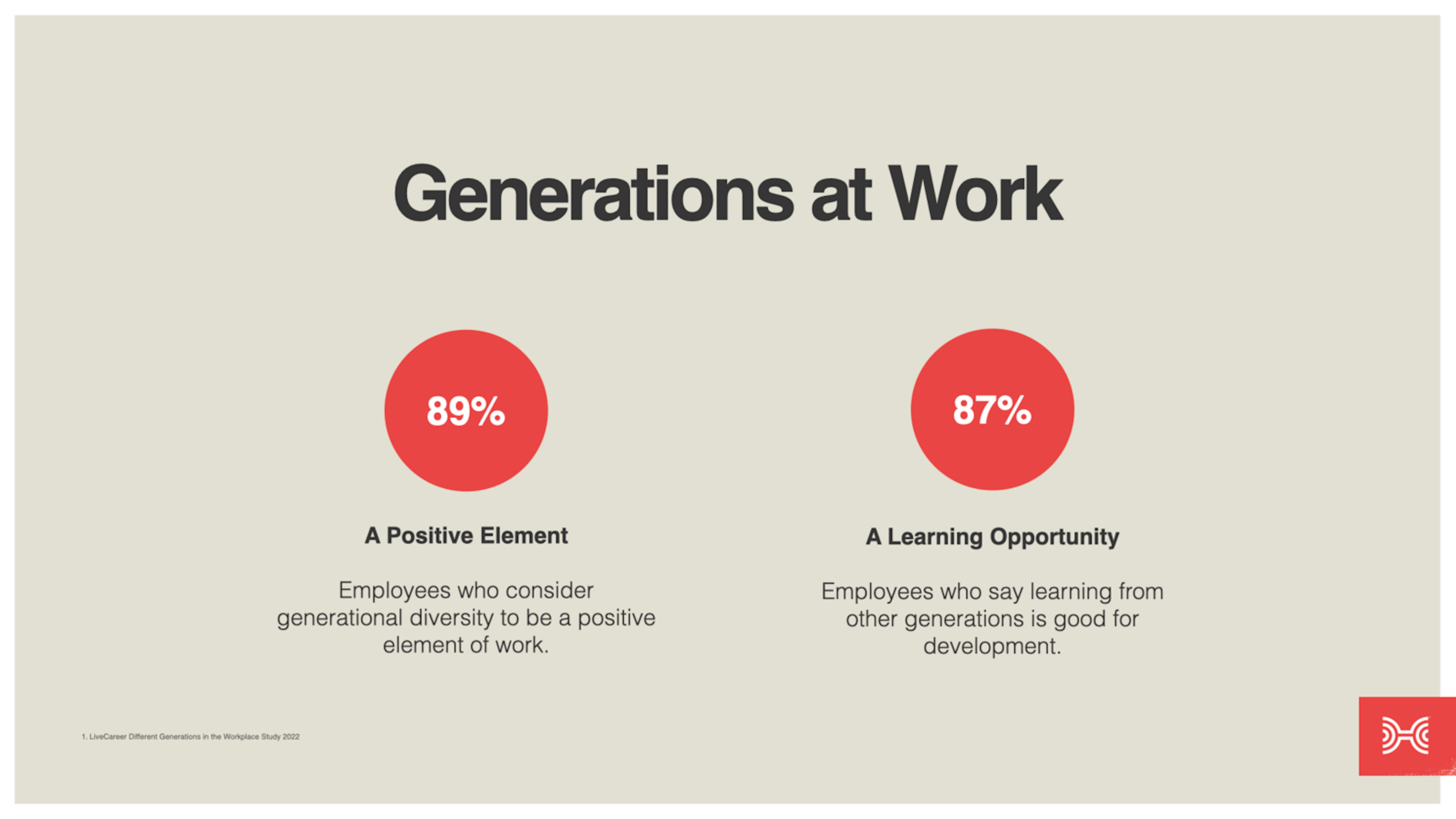
Every generation and team member brings something to the table. Eighty-nine percent of employees consider generational diversity to be a positive element of work, and 87% say learning from other generations is good for their own development.
Be intentional about finding ways for employees to work together and learn from one another, like pairing members of different generations up for projects or mentoring programs.
Don’t Play Favorites
As a manager, it can be easy to strongly identify with team members who are closest to us in age. “Ingroups” or a group of people who you identify as being part of, can easily form around age in the workplace.
For example: If a manager is a millennial and displays favoritism toward fellow millennials on the team, an ingroup is likely to form. The more we identify with an ingroup, the more distanced we feel from outgroup members, and the more likely we are to demonstrate unfair bias toward them.
Our multigenerational teams suffer when ingroups and their resulting bias are left unchecked. Research shows that outgroup members can experience everything from reduced physical well-being to decreased job satisfaction, as well as withdrawal behaviors like increased tardiness, absenteeism, and turnover.
Challenge Harmful Stereotypes
Age-related stereotypes abound in our society, and the workplace isn’t immune. Managers should be careful to avoid relying on blanket statements or generalizations about members of any generation when leading a multigenerational team.
The presence of negative age-related stereotypes isn’t only discriminatory and wrong, they can truly result in reduced employee performance, even when an employee was previously a strong performer at work. Imagine team members who become so worried about confirming a negative age-based stereotype that it impedes their ability to focus, causing their performance to suffer. This creates a vicious cycle, and the stereotype becomes self-fulfilling.
Understanding generational preferences can be helpful, but relying on outdated stereotypes like “Baby Boomers don’t know how to use technology” is not. Be prepared to address this behavior within your team if it exists.
Remember How We’re Alike
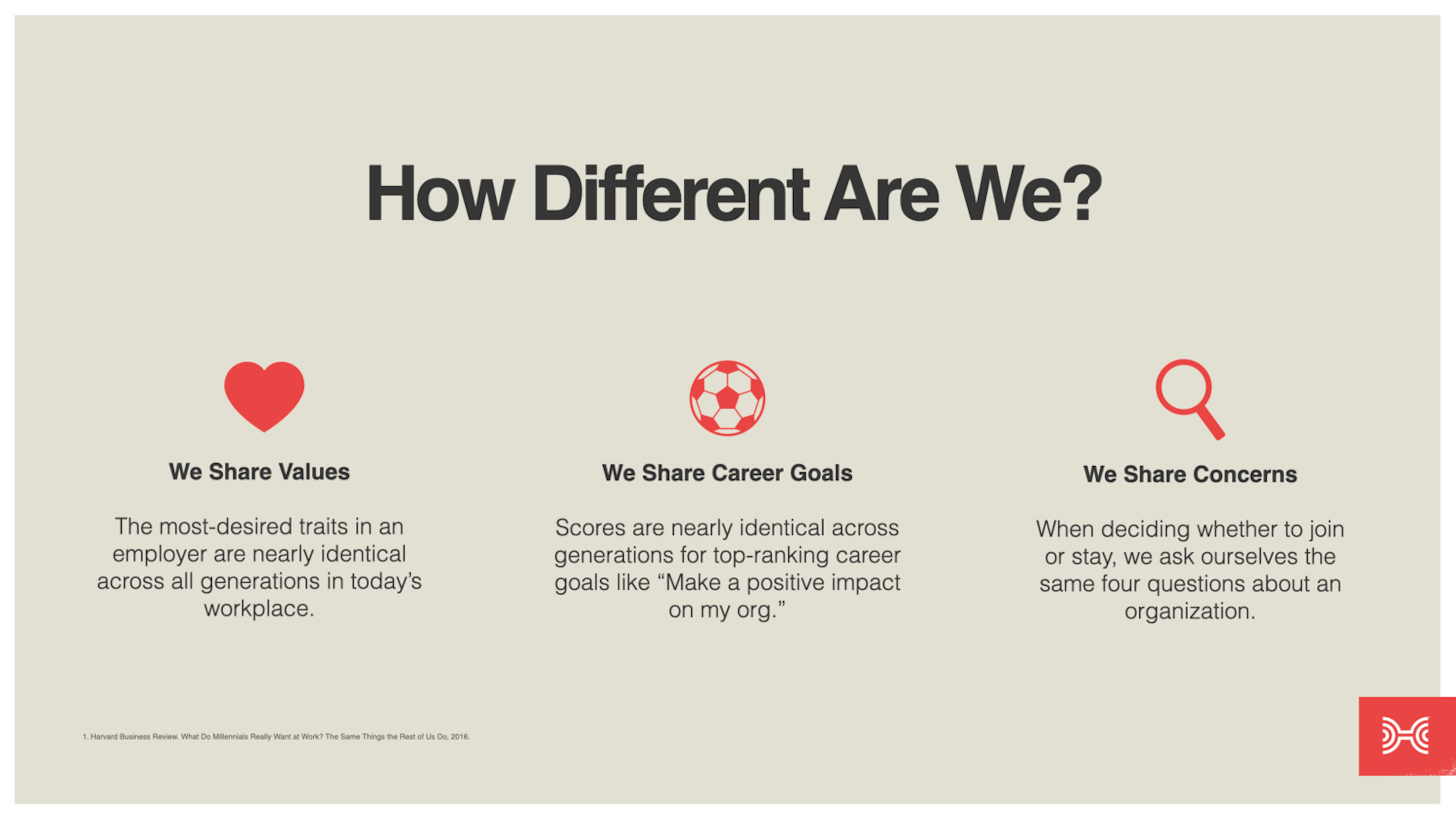
Despite what news headlines might lead one to believe, Baby Boomers, Generation X, Millennials, and Generation Z have a lot in common when it comes to what they want and value at work. Members of each generation are largely aligned when it comes to values they look for in an employer, their personal career goals, the questions they consider when deciding to join an organization, and the traits they want their manager to have.
Fundamentally, most employees desire a blend of three things in their work: challenge, balance, and authenticity. The one or two elements an employee desires the most in their work will always be shifting, much like a kaleidoscope.
Develop Essential Skills
Like we mentioned in part two, strong management competencies can go a long way in cutting across generational differences. Managers should devote time and energy to developing essential skills. When managers become more effective communicators, learn to manage arguments, can create a culture of accountability, and lead with emotional intelligence, they will be able to make the most of any team.
Looking for a more precise “dollars and cents” approach to management training? Leading research indicates that every one dollar spent on training a manager returns more than four dollars to the organization. Put another way: the ROI on management training, annually, is up to 415% of the initial cost.